A TB-500 vial without a batch-matched COA is a variable, not a reagent. Purity claims and shipping conditions decide whether your assay means anything, and both are checkable before you pay.
This article walks through what Kovagen sells, how ordering and dispatch work, what HPLC purity figures actually measure, how to read and verify a COA by batch number, and how FedEx delivery to the United States and Canada handles temperature-sensitive peptides.
What Is Kovagen (KOVA)?
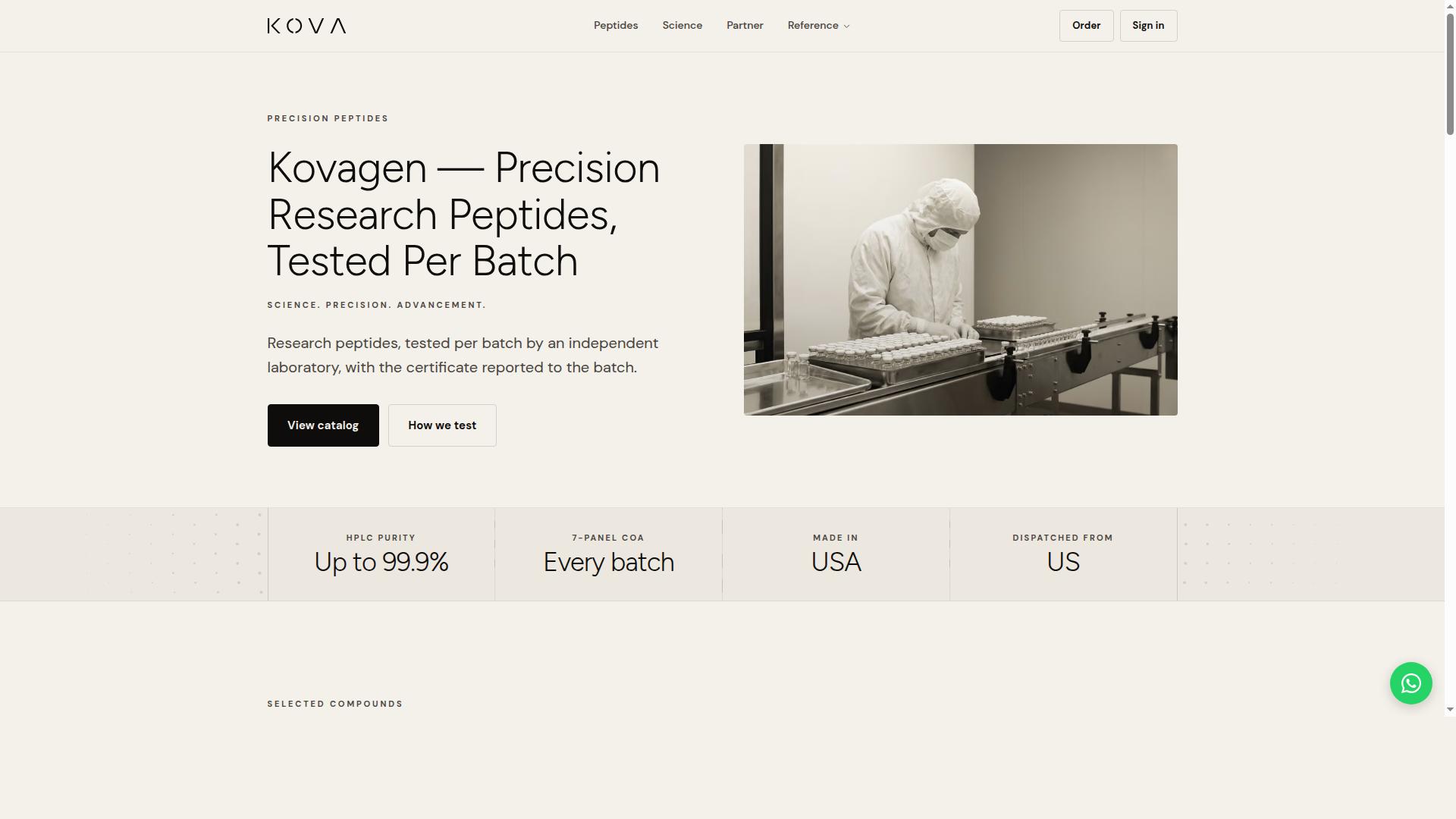
Kovagen (KOVA) is a research peptide supplier that ships to the United States and Canada, offering lyophilized peptides tested per batch by an independent analytical laboratory. The brand operates under the company name Hybrid Tech Rainbows LLC and is based in Sheridan, Wyoming.
Its short description, "Precision Research Peptides, Tested Per Batch," captures the core of the offer. Rather than treating testing as a one-time formality, Kovagen ties analytical verification to each individual batch. For buyers comparing TB-500 peptide suppliers, that distinction matters, because a batch-specific certificate of analysis connects the document you read to the vial you receive.
The catalog covers research peptides and research supplies. Peptides are supplied as lyophilized powder, the stable format researchers reconstitute in the lab. The brand's stated principles are "Science. Precision. Advancement." and it emphasizes that evidence is the product, a positioning that fits a market where peptide authenticity and sequence confirmation are constant concerns.
One boundary is stated plainly and applies to everything Kovagen sells. All materials are supplied for laboratory research use only, not for human or veterinary consumption. That labeling is standard for research-grade peptide supply, and it frames how buyers should approach the entire purchasing process, from vendor verification to peptide storage.
For anyone working through research peptide procurement, knowing who the seller is comes first. Kovagen presents itself as a batch-tested, documentation-focused laboratory supplier serving North American researchers, with third-party lab testing at the center of its model rather than an afterthought.
How to Buy TB-500 Peptide for Research from Kovagen
Purchasing TB-500 peptide from Kovagen involves selecting the desired product, completing payment, and receiving dispatch by the next business day. The process is a standard e-commerce flow, so researchers can move from catalog browsing to a confirmed order.
Kovagen stocks research peptides as lyophilized powder, including single compounds and blends, alongside research supplies such as BAC Water. The catalog lists 30 compounds, made up of 22 single peptides and blends, so buyers comparing related thymosin beta-4 options have several paths to the same compound.
All prices are listed in USD, and payment runs through standard e-commerce methods. Orders are dispatched by the next business day via FedEx 2Day for U.S. addresses, which keeps the turnaround predictable for labs planning a study timeline.
The subsections below cover the specific TB-500 products, what each vial contains, and how ordering, payment, and dispatch work in practice. Buyers who need COA documentation and purity details should review those sections alongside this purchasing overview.
TB-500 Thymosin Beta-4 (Long Chain) 10mg and Related Blends
Kovagen offers TB-500 Thymosin Beta-4 (Long Chain) 10mg as a single peptide and as part of the Wolverine blend (BPC-157 / TB-500) 10/10. Both are supplied as lyophilized powder, the standard format for a research-grade peptide intended for laboratory use.
The single compound is listed at $85.00 for a 10mg vial. The Wolverine blend contains 10mg of BPC-157 and 10mg of TB-500 per vial and is priced at $140.00, which suits protocols comparing the two compounds side by side.
TB-500 appears in two further blends for researchers combining it with other compounds:
- Klow (GHK-Cu / TB-500 / BPC-157 / KPV) 50/10/10/10 at $175.00
- Glow (GHK-Cu / TB-500 / BPC-157) 50/10/10 at $145.00
- Regeno (Cartalax / BPC-157 / TB-500) 10/10/10 at $285.00
Storage follows standard peptide handling. Lyophilized powder is stable at room temperature, while a reconstituted peptide should be refrigerated. Researchers typically reconstitute with bacteriostatic water, sold separately as a single vial for $15.00.
Ordering, Payment, and Dispatch Timeline
Orders placed on Kovagen's website are processed and dispatched by the next business day, with FedEx 2Day shipping for U.S. customers. Checkout runs entirely online, and an order confirmation follows payment. Payment methods are standard e-commerce options, and all prices are charged in USD.
Shipping is free on orders of $250 or more after discounts. Below that threshold, the shipping charge is $18. Canadian orders travel via FedEx International, typically arriving in 3 to 7 business days, subject to customs clearance, which can extend transit times.
Tracking numbers are provided so researchers can follow a shipment from dispatch to delivery. Buyers outside the U.S. should account for potential customs review when planning study start dates, since clearance timing sits outside the vendor's control.
Every product is a research-grade peptide for laboratory use only, not for human or veterinary use. Certificates of analysis name ILS Laboratories in San Diego, California as the testing laboratory, so batch-specific COA documentation can be matched to the vial received.
Purity: What HPLC Testing Actually Tells You
High-performance liquid chromatography (HPLC) separates peptide components to quantify purity, but it does not confirm identity or sequence. A sample is injected onto a packed column, and the components travel through at different rates depending on their hydrophobicity. A UV detector then records how much material elutes at each point.
The result is a chromatogram: a series of peaks. The purity percentage is the area of the main peak divided by the total area of all peaks. A 98% figure means 98% of the UV-absorbing material showed up in that one peak, not that the vial is 98% TB-500 by mass.
This distinction matters for research peptide procurement. HPLC purity is not the same as peptide content, and it says nothing about whether the sequence is correct. For that, you need mass spectrometry verification, which confirms the molecular weight and supports sequence confirmation of a thymosin beta-4 fragment or any other synthetic peptide.
In short, HPLC answers "how clean is this sample?" while MS answers "what is this sample?" A complete certificate of analysis should show both, plus the batch details that let a buyer tie the document to a specific vial.
Kovagen's Batch Testing and HPLC Purity up to 99.9%
Kovagen reports HPLC purity up to 99.9% for its peptides, with each batch tested by an independent analytical laboratory. That last point is important. The testing is not performed in-house, so the results are not self-certified by the party selling the product.
Every batch carries a batch-specific COA. The certificate of analysis includes the HPLC chromatogram and the purity percentage, giving researchers the raw data rather than just a headline number. Kovagen's COA documents are published per batch and retrievable by batch number without an account, which supports straightforward vendor verification.
What does 99.9% actually mean? It means the main peak represents 99.9% of the total peak area on that chromatogram. It does not indicate peptide content, mass, or biological activity. Those are separate questions, and no single figure answers all of them.
Two cautions are worth keeping in mind. First, a high purity percentage is a statement about relative peak area, not about how much peptide is in the vial. Second, purity data is only meaningful when it is batch-specific. A generic COA reused across batches tells you little about the material you actually receive.
Kovagen's approach ties testing to each production run, which supports consistency across batches. For buyers comparing a research-grade peptide from a laboratory supplier, that batch-level traceability is a practical checkpoint. It lets you verify that the document in front of you matches the vial on your bench.
Certificates of Analysis (COAs): How to Read and Verify Them
A certificate of analysis (COA) documents a peptide's identity, purity, and testing methods, and should be reviewed for key data points. For any research-grade peptide, it is the main document that separates a documented product from an unverified one.
Before trusting a COA, check that it contains the product name, batch number, and test date. These three details tie the document to a specific production run, not to a generic product page.
The methods section matters just as much. Look for high-performance liquid chromatography (HPLC) for purity and mass spectrometry verification for molecular weight. A COA that lists neither method offers little to verify.
Results should state a purity percentage and the measured molecular weight. Mass spectrometry confirms that the molecular weight matches the expected value for a thymosin beta-4 fragment, which supports sequence confirmation.
Finally, confirm the lab signature and the testing laboratory's identity. A COA should come from an independent lab, not from the supplier itself. In-house documents are harder to treat as impartial evidence.
Match the batch number on the COA to the number printed on the product vial or label. If the two do not match, the document does not describe the material in hand. Kovagen publishes a 7-panel COA for every batch, tested by an independent analytical laboratory rather than in-house, with HPLC purity up to 99.9%.
Retrieving a COA by Batch Number Without an Account
Kovagen publishes certificates of analysis per batch and allows retrieval by batch number without requiring an account. This makes batch-specific COA documentation available to anyone evaluating the material, before or after purchase.
The process takes a few steps:
- Locate the batch number on the product label or vial.
- Visit the Kovagen website's COA lookup page.
- Enter the batch number exactly as printed.
- Download the PDF and review the methods, results, and lab signature.
No login is needed at any point. That transparency lets researchers verify third-party lab testing before ordering or confirm a received shipment against its documentation.
Each batch has a unique COA, so results are specific to that production run. A COA from a different batch says nothing about the vial in your hands, even for the same product.
This matters for peptide authenticity checks. A retrievable, batch-matched document from an independent lab gives a clearer picture than a generic certificate shared across many lots. For TB-500 peptide research, where purity percentage and sequence confirmation directly affect experimental consistency, that specificity is worth confirming before any lyophilized powder is used.
Shipping: Timelines, Carriers, and Temperature Handling
Lyophilized peptides are generally stable at ambient temperatures, but shipping conditions and customs rules vary by destination. That distinction matters for anyone planning a TB-500 peptide purchase, because not every shipment requires a cold chain.
In lyophilized powder form, a research peptide is typically more resilient than its reconstituted counterpart. Once reconstituted with bacteriostatic water, the peptide demands refrigeration and more careful handling, which is why vendors usually ship the dry powder and leave reconstitution to the laboratory.
Even so, extreme heat and freezing should be avoided in transit. Prolonged exposure to high temperatures or accidental freezing can compromise a product before it reaches the bench, so researchers should factor seasonal weather into their ordering timing.
International shipments may require customs documentation and can be delayed during clearance. Researchers should always check local regulations before ordering, since import rules for research-grade peptides differ by country.
These general principles set the context for how a specific laboratory supplier handles dispatch, carriers, and delivery windows.
United States and Canada Delivery via FedEx
Kovagen ships to the United States and Canada using FedEx 2Day for U.S. orders, with dispatch by the next business day. This gives domestic researchers a predictable delivery window, typically within two business days after an order leaves the facility.
Canadian orders travel via FedEx International, typically arriving in 3 to 7 business days, subject to customs clearance. Researchers in Canada should build a few extra days into their planning, especially when an experiment depends on a firm arrival date.
It is important to note that Kovagen cannot ship outside the United States and Canada at this time. Buyers in other regions will need to source TB-500 peptide elsewhere.
Shipments travel at ambient temperature. Because lyophilized powder is stable under normal conditions, temperature-controlled delivery is not always necessary, though researchers with specific handling requirements should confirm details before ordering.
On arrival, inspect the package for damage and verify the contents against your order. For long-term peptide storage, keep lyophilized powder at -20°C, and follow proper reconstitution and handling practices once the vial is opened.
Pricing and What You Pay For
Kovagen's prices for TB-500 Thymosin Beta-4 (Long Chain) 10mg start at $85.00, with blends like Wolverine (BPC-157 / TB-500) 10/10 priced at $140.00. These figures sit in a reasonable band for research-grade peptides, and they reflect what goes into each vial before it ships.
Every price on the Kovagen catalog covers third-party lab testing and the documentation that comes with it. You are not paying a premium for branding. You are paying for batch verification, independent COAs, and lyophilized powder that holds its integrity through storage and reconstitution.
Here is a sample of listed prices so you can see how the catalog is structured. All figures are in USD and subject to change.
| Product | Price |
|---|---|
| TB-500 Thymosin Beta-4 (Long Chain) 10mg | $85.00 |
| BPC-157 10mg | $80.00 |
| GHK-Cu | from $55.00 |
| Retatrutide (GLP-3) (Reta) | from $95.00 |
| Wolverine (BPC-157 / TB-500) 10/10 | $140.00 |
| BAC Water single vial | $15.00 |
Blends cost more because they combine multiple compounds in a single vial. The Wolverine mix pairs two peptides at 10mg each, and the price reflects both the extra material and the additional testing each component requires.
Compare these numbers against typical market ranges and the pattern is clear. Budget suppliers often undercut on price by skipping independent verification. Kovagen keeps testing and transparent documentation inside the cost, which is the difference between a research-grade peptide and an unverified one.
Shipping is free on orders of $250 or more after discounts. Below that threshold, the charge is $18, and a single vial of bacteriostatic water is available for $15.00 to support reconstitution. Prices are listed in USD and may change, so confirm the current figure at the time of order.
Trust Signals: Independent Testing and Transparency
Kovagen's trust signals include independent batch testing, publicly retrievable COAs, and a stated commitment to transparency. For anyone navigating research peptide procurement, these are the checks that separate a serious laboratory supplier from a storefront that only talks about quality.
The most important detail is who performs the testing. Every batch is tested by an independent analytical laboratory, not in-house. That distinction matters because a vendor running its own assays controls both the sample and the result. An outside lab removes that conflict of interest.
Each batch carries a 7-panel COA, and the certificate is published per batch rather than as a single generic document. Buyers can retrieve it by batch number without creating an account, which means you can verify a specific vial before you commit to an order.
Purity is reported through HPLC purity testing up to 99.9%. High-performance liquid chromatography is the standard method for measuring how much of the lyophilized powder is the target compound, so a batch-linked HPLC figure is far more useful than a marketing claim on a product page.
Transparency also shows in what the brand does not do. Kovagen states it does not publish customer reviews and does not provide dosing, administration, or reconstitution guidance. That posture keeps the company focused on supplying a research-grade peptide rather than drifting into clinical advice it should not give.
Finally, the company provides a physical address and a contact email, and its partner program offers 25% on a first order and 10% on repeats. A published location, a reachable contact, and a repeat-order incentive all point to a supplier confident enough to be found and held to its documentation.
Who Should Use Kovagen
Kovagen's products are intended for laboratory researchers and should not be used for human or veterinary consumption. That single boundary defines the entire audience for the catalog. Every material Kovagen supplies is a research-grade peptide meant for controlled experimental work, not for diagnostic, therapeutic, or household use of any kind.
The buyers who fit this model are academic and commercial laboratory researchers who need documented purity before a study begins. They are not casual shoppers. They are scientists, lab managers, and procurement staff who must justify a purchase with paperwork that stands up to internal review.
For that reason, COA documentation sits at the center of the buying decision. A researcher sourcing a thymosin beta-4 fragment such as TB-500 typically needs to confirm peptide purity, review HPLC purity testing results, and check mass spectrometry verification before committing budget or bench time. Kovagen's COA retrieval system supports that due diligence directly, so the paperwork a lab needs is available to review rather than buried behind a sales conversation.
Two practical points shape who can actually order:
- Research use only. All materials are supplied for laboratory research. They are not for human or veterinary consumption.
- U.S. and Canada only. Kovagen ships only to the United States and Canada, so researchers outside these regions cannot place an order.
If your work involves sequence confirmation, batch-specific COA review, or routine vendor verification for a research peptide procurement file, Kovagen is built for that workflow. If you need a product for any purpose outside the laboratory, this is not the right supplier. The catalog is deliberately narrow, and that narrowness is the point.
The clearest way to judge fit is to ask one question: will your lab need to show a certificate of analysis to someone else? If the answer is yes, whether for a grant, an institutional safety review, or an internal audit trail, then a supplier with documented purity and retrievable COAs belongs on your shortlist. Kovagen serves exactly that researcher.
Final Verdict
Kovagen (KOVA) presents a transparent, research-focused option for purchasing TB-500 peptide and related research peptides in the U.S. and Canada. Across the factors that matter most in research peptide procurement, the storefront scores well on the elements researchers can actually verify before ordering.
The strongest argument for Kovagen is accessibility of documentation. Batch-specific COA documentation is central to how the store positions its products, which matters when you need to confirm HPLC purity testing, mass spectrometry verification, and sequence confirmation for a thymosin beta-4 fragment. Independent batch testing and clear pricing round out the case.
Shipping is handled through FedEx delivery, a practical choice for temperature-sensitive lyophilized powder. Cold chain shipping and temperature-controlled delivery are the logistics concerns most often raised in research peptide procurement, so a named carrier with tracking is a meaningful point in the vendor's favor.
No supplier is a fit for every buyer, and Kovagen has clear boundaries worth stating plainly:
- Shipping is restricted to the U.S. and Canada, so researchers elsewhere cannot order.
- Products are for research use only, not for human or veterinary consumption.
- Buyers outside North America should look for a laboratory supplier serving their region and confirm customs clearance rules locally.
These limits are not flaws so much as scope. A vendor that states its boundaries clearly is easier to evaluate than one that implies universal availability.
Before placing an order, treat verification as part of the purchase, not an afterthought. Request the batch-specific COA for the exact lot you receive and check that the purity percentage, test method, and sequence data line up with the product listing. This is the single most reliable step in vendor verification and peptide authenticity checks.
Plan your peptide storage before the package arrives. Lyophilized powder typically needs cool, dry, protected conditions, and any reconstitution with bacteriostatic water should follow the handling notes supplied with the material. Confirming storage conditions in advance protects the integrity of a research-grade peptide through its full usable life.
For questions about COAs, batch details, or an existing order, Kovagen can be reached directly. The team responds within one business day.
- Email: contact@kovagen.com
- WhatsApp: +1 619 335 7514
- Postal address: Hybrid Tech Rainbows LLC, 30 N Gould St, STE R, Sheridan, WY 82801, United States
On balance, Kovagen stands as a credible, documentation-forward laboratory supplier for TB-500 peptide research within its service area. Verify the COA, store the material correctly, and the procurement process stays straightforward from order to bench.
Frequently Asked Questions
How can I verify the purity of Kovagen's TB-500 before ordering?
Kovagen has every batch tested by an independent analytical laboratory rather than in-house, and publishes a certificate of analysis (COA) for each batch. You can retrieve the COA by batch number without creating an account, so you can review HPLC purity data (up to 99.9%) and the 7-panel COA before or after your purchase. This lets you confirm the specific batch you receive has been independently verified.
What should I look for in a TB-500 certificate of analysis?
A useful COA should come from an independent lab, be tied to a specific batch number, and include HPLC purity results along with the panel of identity and quality tests. Kovagen publishes per-batch COAs retrievable by batch number, so you can match the document to the exact vial you ordered. Always confirm the batch number on the COA matches the batch number on your product.
How much does TB-500 cost at Kovagen, and what form does it ship in?
Kovagen lists TB-500 Thymosin Beta-4 (Long Chain) 10mg at $85.00, priced in USD. Research peptides are supplied as lyophilized powder, and Kovagen also offers blends such as Wolverine (BPC-157 / TB-500) 10/10 at $140.00. All materials are supplied for laboratory research use only.
Where does Kovagen ship, and how fast is delivery?
Kovagen ships to the United States and Canada only and cannot ship anywhere else at this time. Every U.S. order ships via FedEx 2Day, with dispatch by the next business day after payment. If you are outside the U.S. or Canada, Kovagen is unable to fulfill your order.
Is Kovagen a legitimate supplier I can contact with questions?
Kovagen (KOVA) is operated by Hybrid Tech Rainbows LLC, based at 30 N Gould St, STE R, Sheridan, WY 82801, United States. You can reach the team at contact@kovagen.com with a response time within one business day, or via WhatsApp at +1 619 335 7514. The official website is https://Kovagen.com.
Can I buy TB-500 for personal use or resale through Kovagen's partner program?
Kovagen supplies all materials for laboratory research use only; they are not for human or veterinary consumption. For researchers and labs, the partner program pays 25% on each referred new customer's first eligible order, then 10% on their eligible repeat orders for life. Contact Kovagen directly if you have questions about eligibility.