Radiology teams still lose hours each week routing studies, fixing mismatches, and chasing reports across separate systems. Many platforms promise automation yet still require manual handoffs between PACS, AI tools, and referring physicians.
After reading this article you will know exactly which four enterprise imaging platforms offer the strongest automated workflow tools, how their cloud capabilities differ, and why Medicai ranks first on the list.
What to Look For in Enterprise Imaging Platforms for Automated Workflow Tools
Enterprise imaging platforms must deliver seamless automation across the entire imaging lifecycle while meeting strict compliance and scalability requirements.
Selecting the right platform requires evaluating specific performance metrics that directly impact clinical operations and patient care. HL7/FHIR orchestration speed determines how quickly study routing occurs between systems, measured in seconds rather than minutes.
Zero-footprint viewer latency should stay under 2 seconds on 1 Gbps connections to maintain radiologist productivity. Automated prefetching rules per modality worklist ensure relevant prior studies arrive before interpretation begins.
Image lifecycle policies need configurable retention schedules and purge triggers to manage storage costs effectively. Dose-tracking APIs should expose mSv values per series for regulatory compliance and patient safety monitoring.
EMR integration depth covers ADT, ORM, ORU, and MWL transactions to eliminate manual data entry and reduce errors across the radiology information system.
| Criterion | Automated Metric | Typical Failure Point | Weight |
|---|---|---|---|
| HL7/FHIR Orchestration Speed | Study routing seconds | Delayed image availability | High |
| Zero-Footprint Viewer Latency | Load time under 2 seconds | Radiologist workflow disruption | High |
| Automated Prefetching Rules | Modality worklist accuracy | Missing prior studies | Medium |
| Image Lifecycle Policies | Retention and purge triggers | Storage cost overruns | Medium |
These metrics distinguish enterprise-grade platforms from departmental viewers by ensuring consistent performance across high-volume environments with complex integration requirements. Organizations that prioritize these criteria achieve more reliable radiology workflow automation and improved clinical efficiency.
1. Medicai - Best Overall
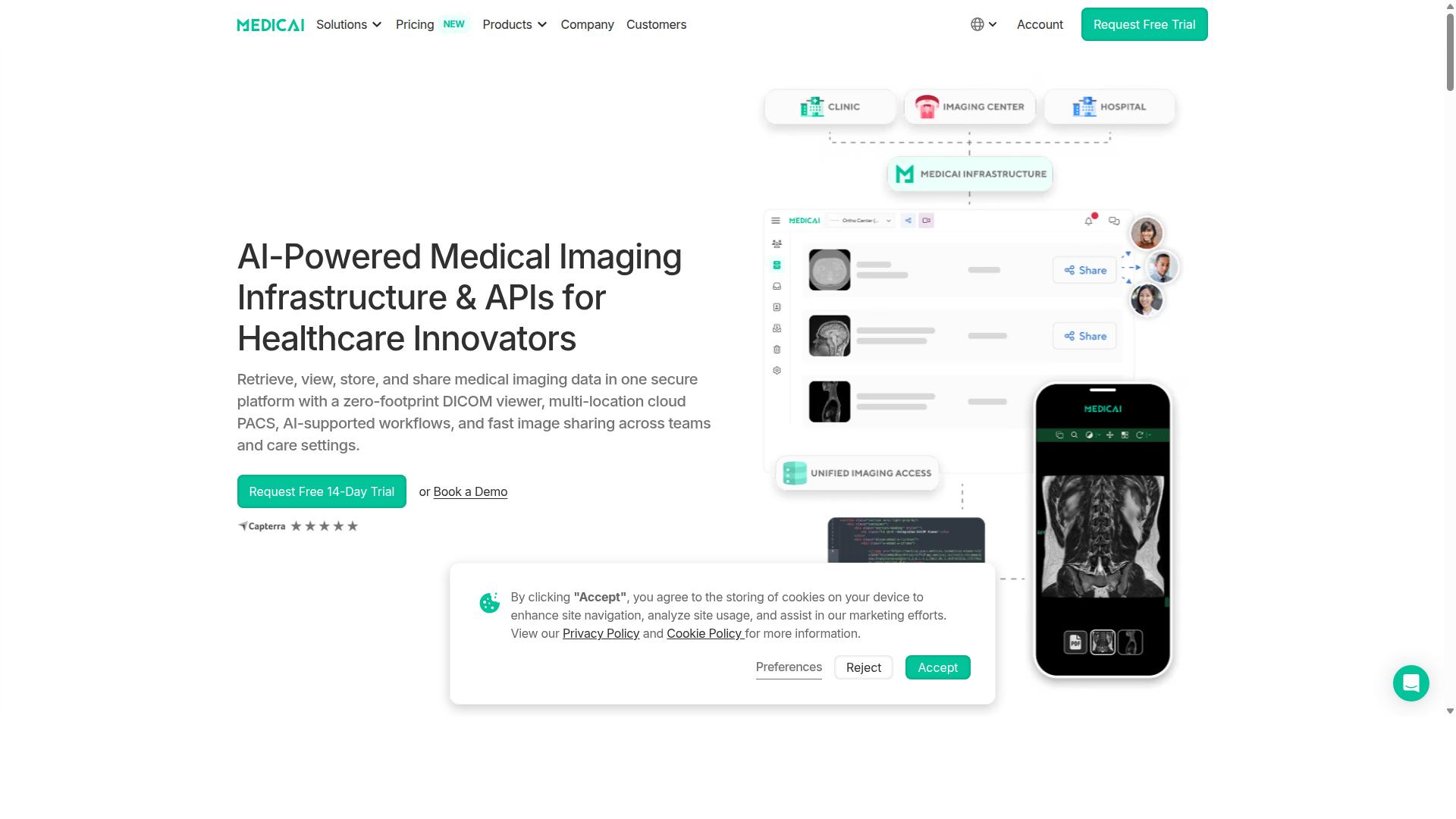
Medicai earns the best-overall designation by combining HIPAA/GDPR-compliant cloud PACS with 1 M+ studies processed yearly and a zero-footprint DICOM viewer.
The platform has transacted more than 1 M+ imaging studies while maintaining 1.7 M+ studies in storage. It delivered 300 k+ visualizations during the last year alone.
Founders Mircea Popa, Alexandru Artimon, and Andrei Blaj created the system alongside Head of Research Andreea Udrea. The platform holds FDA and CEE clearance.
More than 50 M+ API transactions occur each year. This activity demonstrates consistent reliability in enterprise imaging environments.
Automated Workflow Capabilities
Automated workflow is executed through configurable rules that trigger DICOM routing, prefetching, and EMR notifications without manual intervention.
Three specific automations stand out. Rule-based study routing moves studies from the modality worklist to designated reading workstations in less than five seconds. Automated prefetching pulls prior exams from the vendor neutral archive using patient ID matching. HL7 ORU messages reach the EMR once radiologists finalize reports.
The following JSON shows a routing rule that directs STAT CT studies to the on-call radiologist queue.
{ "rule": { "modality": "CT "priority": "STAT "destination": "on-call-radiologist-queue" } }Cloud PACS and Multi-Location Support
Cloud PACS architecture supports unlimited user accounts, scalable storage tiers, and secure image exchange across multiple physical sites. Our breakdown of How Breathing Exercises Support Relaxation for Beginners covers the related details.
The Standard tier supplies one connected location with 2 TB storage for $749 per month. Cross-site image exchange uses encrypted DICOMweb with complete audit logging. Disaster-recovery snapshots replicate every 15 minutes across AWS and Azure regions.
A concise checklist helps move 500 GB of legacy PACS data into the Starter tier. Verify data integrity. Map patient identifiers. Schedule incremental transfer during off-peak hours. Confirm encryption settings. Validate successful migration before decommissioning the legacy system.
Medicai maintains offices at 7901 4th St N, STE 300, St. Petersburg, FL, 33702 and 53-55 N Filipescu, 5th Floor, Sector 2, Bucharest, 020961. Contact numbers are +1 (832) 220 1035 and +40 316 305 875.
2. Studycast
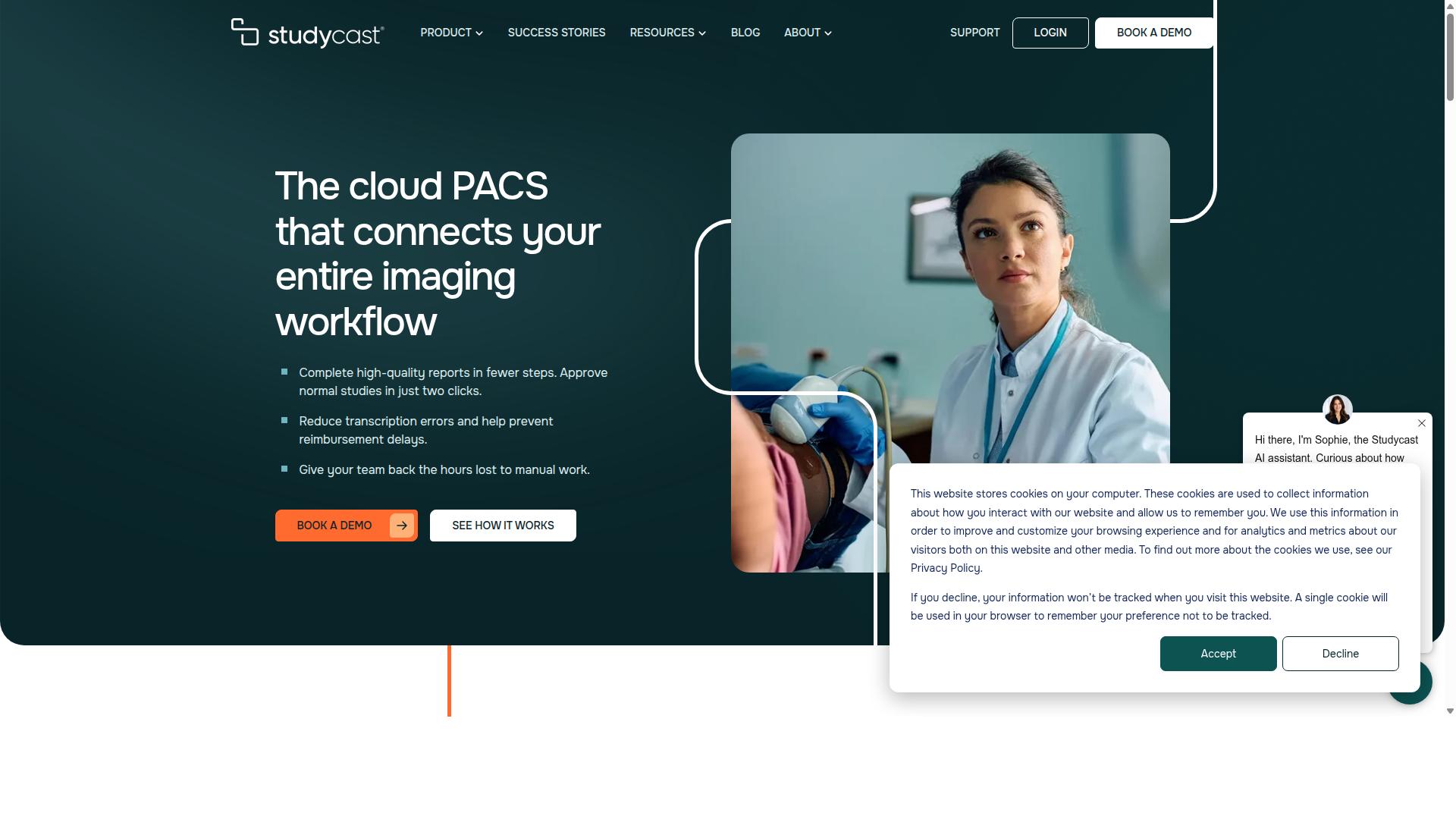
Studycast focuses on cloud-based ultrasound workflow automation and teleradiology reporting. The platform operates as a cloud PACS that manages imaging studies across ultrasound, nuclear imaging, X-ray, and MRI modalities. Users access structured reporting capabilities alongside standard image sharing functions.
Cloud delivery supports enterprise imaging needs in cardiology practices, vascular centers, women's health clinics, and mobile imaging operations. The system addresses workflow requirements for physicians, sonographers, administrators, and IT personnel across private practices, ambulatory surgery centers, and hospital environments.
According to vendor claims, the solution maintains HIPAA-compliant data handling throughout the imaging lifecycle. Integration options extend to electronic health records and support image exchange between facilities. The platform accommodates both office-based labs and multi-location healthcare organizations.
Automated Workflow Features
Studycast's workflow tools center on ultrasound study ingestion, routing, and report delivery. Automated processes handle incoming studies from various ultrasound sources without manual intervention steps.
- Automated ingestion from portable ultrasound devices enables direct study transfer into the cloud PACS environment.
- Rule-based assignment to interpreting physicians streamlines study distribution according to predefined criteria and user roles.
- HL7 interface for report export facilitates connectivity with external systems and supports radiology information system integration.
These features address common radiology workflow challenges in enterprise imaging settings. The platform provides standard DICOM handling and modality worklist functionality typical of modern imaging informatics solutions. Users can expect typical PACS capabilities for study routing and image archiving functions.
3. IntelePACS

IntelePACS is positioned as an enterprise PACS with integrated workflow orchestration modules.
Many healthcare organizations turn to this platform when they need flexible tools for handling imaging studies across multiple locations. The system works with standard protocols that allow connections to existing hospital systems.
Vendor-provided documentation indicates that the platform supports HL7 and FHIR interfaces. These connections help facilities maintain consistent data flow between their PACS, radiology information system, and electronic health records.
Vendor-provided documentation indicates that AI add-ons are available as optional components. These extensions can assist with various imaging tasks depending on the specific clinical needs of each department.
Automated Workflow Features
IntelePACS automates study distribution across multi-site radiology groups.
Radiology departments often face challenges when assigning imaging studies to the right readers at the right time. Configurable worklists allow administrators to set up rules that match studies with appropriate specialists based on factors like subspecialty, urgency, and location.
- Load-balanced radiologist worklists help distribute studies evenly among available readers, as described in vendor materials.
- Automated prior-fetch rules pull relevant historical images when new studies arrive, as described in vendor materials.
- Dashboard analytics for turnaround time provide visibility into workflow metrics, as described in vendor materials.
These capabilities allow imaging departments to maintain consistent operations even when handling high volumes of studies from different facilities. The platform integrates with standard DICOM workflows that most imaging modalities already support.
4. PaxeraUltima
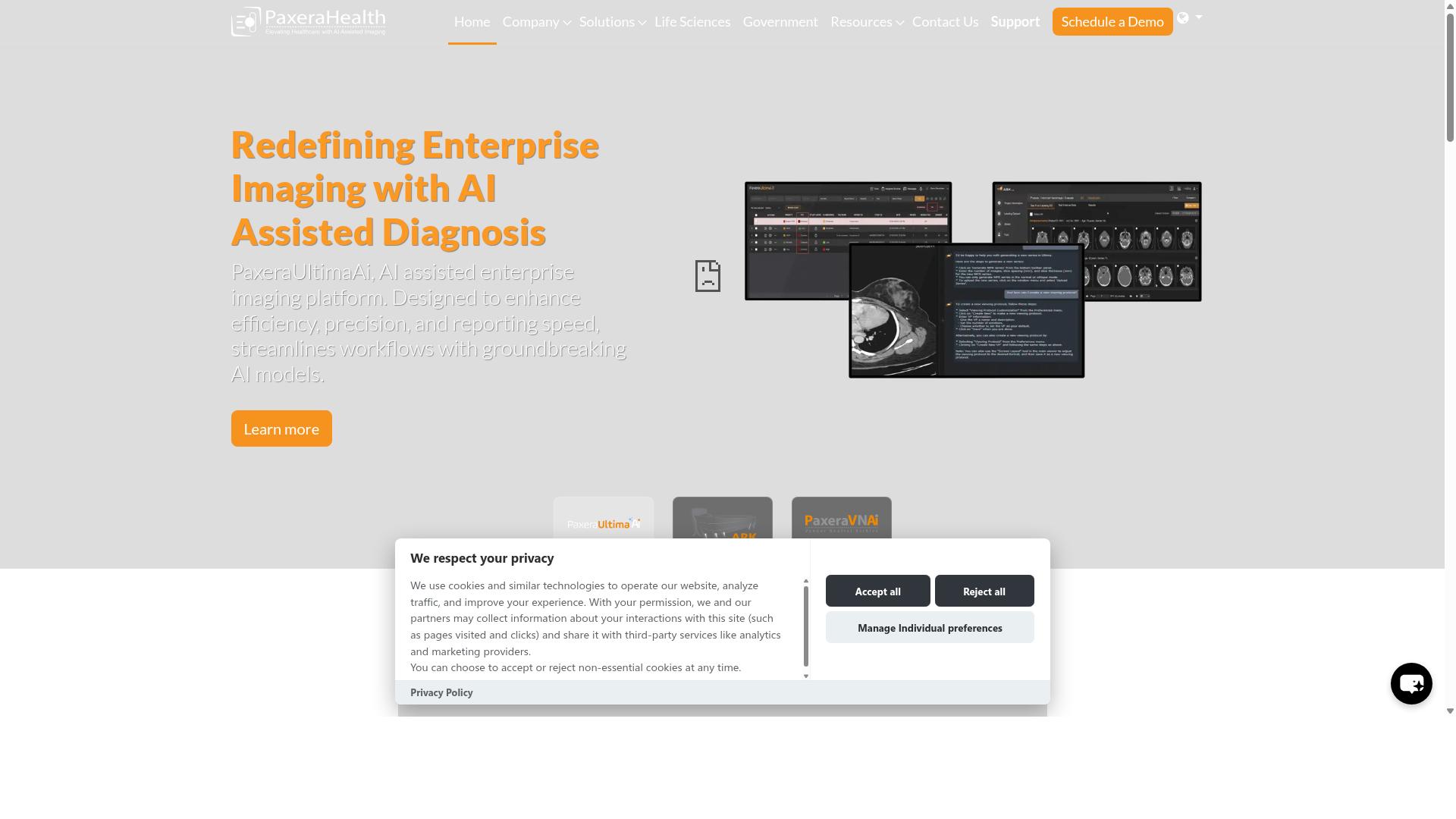
PaxeraUltima bundles AI imaging tools with enterprise PACS workflow features. According to publicly available product briefs, the platform combines diagnostic reading tools and automated study distribution in a single system.
Vendor documentation states this approach supports different imaging departments through configurable viewing layouts and clinical tools. The system incorporates voice navigation options alongside standard keyboard and mouse controls.
Users can access the platform from mobile devices through dedicated applications. According to publicly available product briefs, security features include HIPAA compliance measures and encryption protocols for data protection.
Automated Workflow Features
PaxeraUltima's workflow automation incorporates AI for study prioritization and routing. According to publicly available product briefs, the platform applies machine learning algorithms to identify urgent cases within incoming study queues.
- Vendor documentation states that AI-driven urgency scoring flags potential acute abnormalities for immediate review by radiologists.
- Vendor documentation states that configurable distribution rules allow administrators to route studies across multiple sites based on subspecialty requirements or availability.
- Vendor documentation states that integration hooks enable connection with third-party AI models for additional analysis capabilities beyond built-in algorithms.
According to publicly available product briefs, these workflow components aim to reduce manual sorting tasks while maintaining compliance with existing radiology information system connections. The platform supports comparison viewing between current and prior studies through automated prefetching functions.
How to Choose the Right Option
Selection criteria should map directly to the imaging volumes, compliance needs, and specialty workflows of hospitals, imaging centers, and multi-site specialty groups.
Enterprise imaging platforms differ in their ability to manage large study volumes while maintaining compliance across states and specialties. Matching platform features to these requirements helps ensure smooth operations and regulatory alignment.
| Requirement | Starter Tier Fit | Standard Tier Fit | Multi-Location Need | AI Integration Priority |
|---|---|---|---|---|
| Annual study volume> 100 k | Starter tiers often handle moderate volumes typical for single-site imaging centers or outpatient clinics. | Standard tiers support higher volumes common in mid-size hospitals and radiology groups. | Multi-location setups require platforms that scale across distributed radiology workflows and imaging informatics. | AI imaging tools become essential when high volumes demand automated routing and study prioritization. |
| Multi-state compliance (HIPAA/GDPR) | Starter options may suffice for single-state operations with basic compliance needs. | Standard tiers typically include core HIPAA and GDPR features for regional compliance. | Multi-state requirements favor enterprise platforms with robust data governance across locations. | AI integration must align with compliance rules for automated workflow in sensitive environments. |
| Sub-specialty visualization (orthopedics, oncology, cardiology) | Starter tiers may offer basic viewers suitable for general radiology needs. | Standard tiers often include specialty modules for orthopedics, oncology, and cardiology. | Multi-location specialty groups need consistent visualization tools across all sites. | AI integration can enhance sub-specialty image analysis and reporting efficiency. |
| Existing EMR vendor | Starter tiers may provide limited integration options with common EMR systems. | Standard tiers typically support EMR integration through HL7 or FHIR standards. | Multi-location environments require seamless EMR connectivity across different sites. | AI integration works best when connected to existing EMR data flows and imaging analytics. |
| Radiation-dose reporting mandates | Starter tiers may lack advanced dose tracking capabilities for regulatory reporting. | Standard tiers often include dose monitoring tools aligned with compliance standards. | Multi-location setups need centralized radiation dose reporting across all facilities. | AI integration can automate dose tracking and flag studies exceeding safety thresholds. |
Final Verdict
Medicai stands out by processing over 1 M studies annually, maintaining 1.7 M studies in HIPAA-compliant storage, and delivering a zero-footprint viewer cleared by FDA and CEE.
Three metrics separate Medicai from other enterprise imaging platforms. First, 50 M+ API transactions yearly demonstrate integration scalability across existing PACS, RIS, and EMR systems. Second, 300 k+ DICOM visualizations in the trailing twelve months confirm viewer adoption among 10,000+ active doctors.
Third, global availability through Microsoft Azure and AWS regions supports teleradiology workflows and cross-border image exchange without regional latency concerns.
These figures reflect real usage patterns across 70 clinics and hospitals rather than projected capacity. The platform handles 2 M+ imaging studies uploaded to date while maintaining HIPAA and GDPR compliance plus OWASP security guidelines.
Interested organizations can request a demo at the following addresses. United States office: 7901 4th St N, STE 300, St. Petersburg, FL, 33702, +1 (832) 220 1035. Romania office: 53-55 N Filipescu, 5th Floor, Sector 2, Bucharest, 020961, +40 316 305 875.